
Posts

NEWS- Arquitecturas AIoT

Arquitecturas AIoT: Del Cloud al Edge para una Industria Inteligente

Arquitecturas AIoT

Conventional IoT architecture, based on the massive sending of telemetry to cloud platforms, has reached a turning point. The current cloud-centric model faces insurmountable operational ceilings: variable latencies, increasing bandwidth costs, and the fragility resulting from total dependence on external connectivity.

The evolution towards AIoT (Artificial Intelligence of Things) proposes a necessary paradigm shift: moving inference logic and data management to the network edge (Edge).

The Technical Leap: Data Efficiency and Local Determinism

The goal is no longer simply to “connect an asset,” but to provide the node with computational capacity to execute Machine Learning models in-situ. This approach allows:

  • Reduction of Server Load: By processing information in the field, it avoids saturating cloud storage and computing with irrelevant data.
  • Bandwidth Optimization: Only metadata or actionable events are sent (for example, a failure alert instead of gigabytes of raw vibration data), drastically reducing network traffic.
  • Real-Time Management: Certain critical applications require an immediate response that the Cloud cannot guarantee. Local computing offers the deterministic latency necessary for emergency stops or high-speed process control.

Model Comparison: Cloud vs. AIoT

Technical parameter Cloud-Centric Model AIoT Model (Edge Computing)
Decision latency Variable (ms to seconds) Deterministic (milliseconds)
Network load High (Continuous payload) Low (Send by exception)
Processing CPU/GPU on server Specialized hardware in the field
Operational continuity WAN dependent Local (Autonomous)

Specialized Hardware: The Foundation of Local Inference

For AI at the Edge to be viable, hardware must evolve beyond generic processors. At Matrix, we provide the cutting-edge building blocks to convert passive infrastructures into autonomous systems:

  • Systems on Module (SoM): Based on Qualcomm or Intel Ultra technologies, ideal for integrating AI power into compact, low-power devices.
  • Single Board Computers (SBCs): Equipped with Intel Ultra processors, combining versatility and next-generation performance in a reduced format.
  • High-Performance Edge Computers:
    • NVIDIA Jetson: Leading power in computer vision and parallel computing.
    • Intel Ultra / iCore + NVIDIA RTX: Robust solutions that combine Intel’s processing power with the graphical acceleration of RTX GPUs for the most demanding inference tasks.
  • NPUs (Neural Processing Units): Specific accelerators for tensor operations with minimal energy consumption.

Use Cases: Where AIoT Makes a Difference

  1. Advanced Predictive Maintenance: Processing FFT signals directly on the sensor to detect motor anomalies and activate an immediate stop via PLC, without waiting for a server response.
  2. In-Line Computer Vision: The camera performs the inference (detection of PPE or defects) and only communicates the diagnosis, avoiding network saturation with video streaming.
  3. Smart Energy Management: Real-time load balancing decision-making based on local variables to optimize OEE.

Design and Scalability

When designing an AIoT solution, it is vital to consider the system’s lifecycle. Our architectures support OTA (Over-The-Air) updates via containers (Docker), allowing new models to be re-trained and deployed remotely and securely.

Are you ready to reduce your infrastructure costs and gain greater autonomy?

At Matrix, our engineers will advise you in selecting the ideal hardware — from industrial gateways to high-performance edge computing solutions.
👉 Contact our Engineering Team for a customized project.

Tinker V and Tinker Board 3N

ASUS IoT announces Tinker V RISC-V SBC and Tinker Board 3N with Rockchip RK3568 SoC

ASUS IoT has added two new members to the Tinker board family with the SBC (Single Board Computer) Tinker V and Tinker Board 3N powered by the Renesas RZ/Five single-core RISC-V SoC and quad-core Arm Cortex-A55 processor. Rockchip RK3568 , respectively.

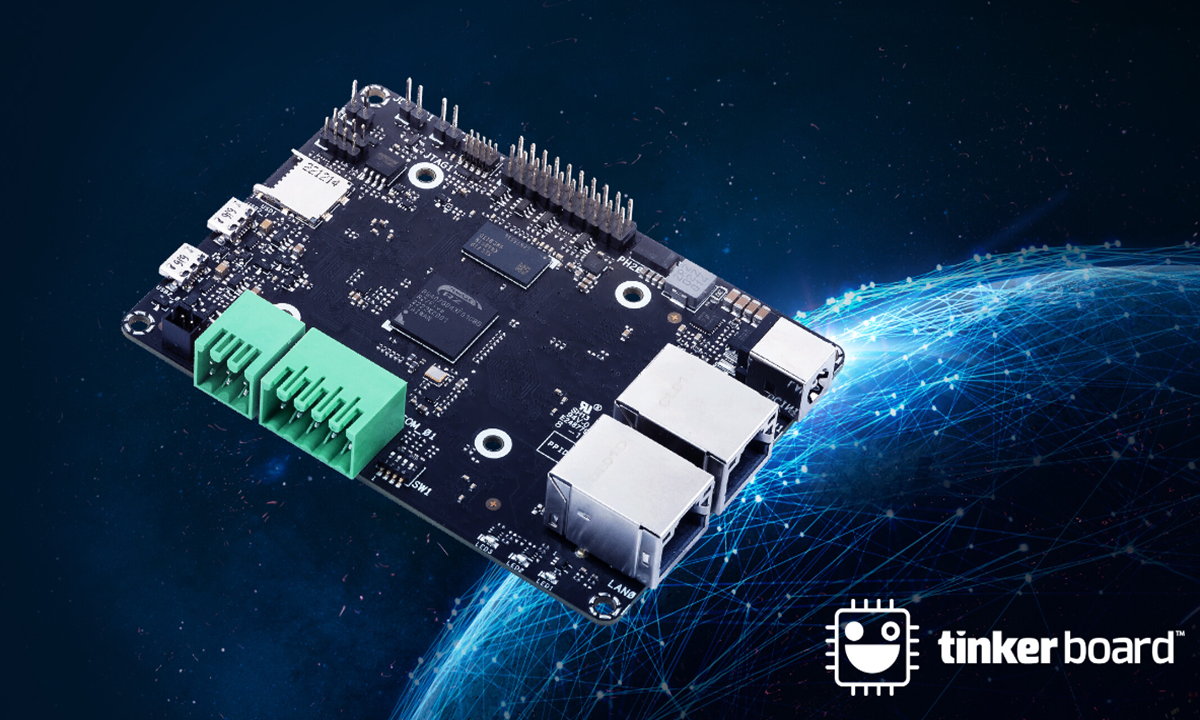
ASUS Tinker V RISC-V SBC

ASUS Tinker V is the  first SBC with a 64-bit RISC-V processor.
It has 1 Gbyte of DDR4 memory, a microSD card slot for storage, and optional support for a 16 GB eMMC module and SPI flash.

  • 2 Ethernet GbE
  • 1 micro USB
  • 1 micro USB (OTG)
  • 2 CAN Bus (6-pin terminal block)
  • 2 COM RS-232 (5-pin terminal block)
  • 20-pin GPIO header
  • JTAG debug pin header
  • DC power input connector

ASUS Tinker V is ideal for industrial IoT applications, specially designed to run Debian Linux and Yocto. With an ultra-compact size, it offers high power, full functionality and great connectivity, making it a perfect choice for a wide range of industrial IoT applications.

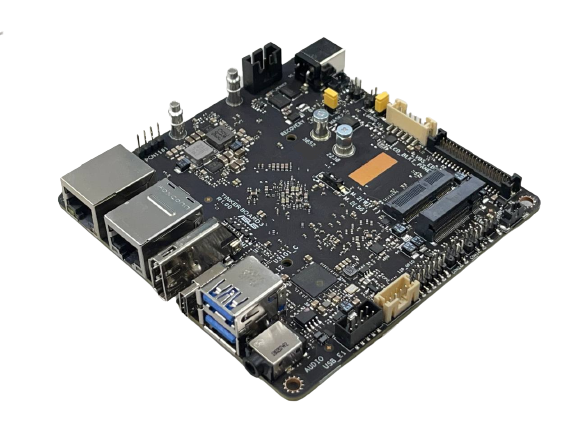
Tinker Board 3N

The 100 x 100mm board incorporates the Rockchip RK3568 , which integrates four ARM Cortex-A55 cores and a Mali-G52 GPU . LPDDR4X RAM memory, with 2 GB, 4 GB or 8 GB available in dual channel.

  • 32 GB and 64 GB eMMC options.
  • MicroSD card reader.
  • M.2 2032 E-Key for connecting Bluetooth/Wi-Fi modems
  • M.2 3042/3052 B-Key for 4G/5G modems.
  • SIM card slot
  • 2 HDMI USB 2.0 and USB 3.2 Gen1 Type-A ports
  • 1 USB 3.2 Gen1 Type-C connection
  • 3.5mm Audio
  • 2 RJ45 ports and a 40-pin GPIO header.
  • Compatible with Android 12 and Debian.

Do you need more info? Our team of specialists is available to help you find the best option for your project. Contact us.


Source: “ASUSIoT”

ASUS Tinker Board – Single Board Computer (SBC) in an ultra-small form factor

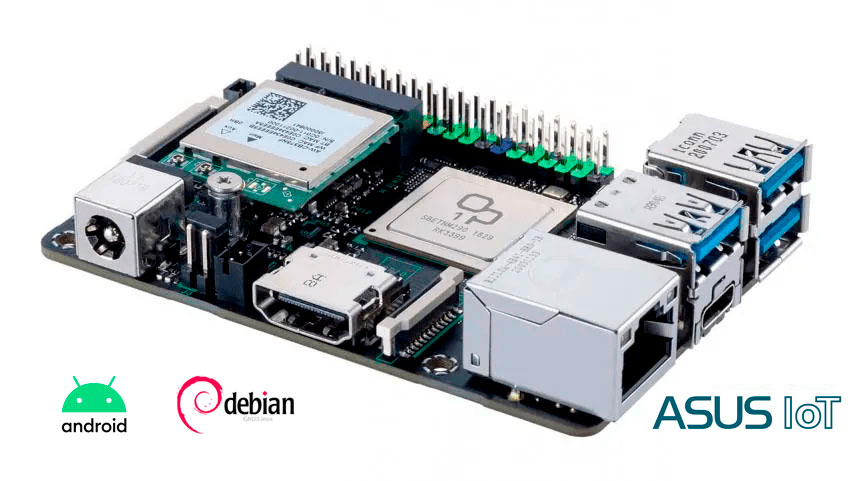
ASUS Tinker Board SBC

Tinker Board is a Single Board Computer (SBC) in an ultra-small form factor that offers class-leading performance while leveraging outstanding mechanical compatibility. The Tinker Board offers creators and developers a reliable and extremely capable platform for building and tinkering their ideas into reality.

Leading Performance

With its powerful and modern quad-core ARM-based processor — the Rockchip RK3288 — Tinker Board offers significantly improved performance versus other popular SBC boards. To provide the flexibility needed for different builds and projects, Tinker Board features 2GB of LPDDR3 dual-channel memory. Tinker Board is also equipped with an SD 3.0 interface that offers significantly faster read and write speeds to expandable microSD cards used for the OS, applications and file storage.

Robust GPU Performance & Functionality

Featuring a powerful and energy efficient design, the Tinker board supports the next generation of graphics and GPU Compute API. Powered by the ARM-based Mali T764 GPU, its GPU enables a wide range of uses, including high-quality media playback, gaming, computer vision, gesture recognition, image processing and stabilization, photography, and much more. Multimedia enthusiasts will appreciate the H.264 video and audio encoders and H.265 compatibility, including HD and UHD* video.

HD Audio Quality

This is an improvement in key areas that many SBC cards lack, Tinker is equipped with an HD codec that supports up to 192kHz/24-bit audio. The audio jack can support both audio and microphone output, without an extension module.

Multiple IoT Connectivity Options

The Tinker Board features standard connectivity options, including a 40-pin GPIO interface that allows connection to a range of inputs from buttons, switches, sensors, LEDs, and more. Tinker Board is equipped with a DSI MIPI connection for displays and touch panels. The secondary CSI MIPI connection is for connection to compatible cameras that enable computer vision, and much more.

Tinker Board also features Gbit LAN for Internet and network connectivity. A dedicated bus resource designed for the LAN port ensures consistent Ethernet performance. The integrated Wi-Fi and Bluetooth controller on the Tinker Board is protected with a metal cover to ensure minimal interference and better radio performance. An integrated IPEX antenna connector allows for easy antenna replacement or upgrades.

Tinker Board also features a full-size HDMI output that avoids the use of adapters. Plus, it includes four USB 2.0 or 3.2 ports for extensive peripheral and accessory connectivity.

Improved DIY design

Creators will appreciate the visibility and clarity of the GPIO connector enhancements as they are color segmented for quick and easy recognition.

The Tinker Board’s PCB, dimensions, and topology meet a standard that makes it compatible with a multitude of chassis and accessories. The built-in MIPI headers also have colored tabs.

Tinker Board includes a heat sink, which helps to better work under heavy load or in hot environment.

TinkerOS ‧ Supported OS ‧ Applications

A Debian-based distribution ensures a smooth and functional experience, right out of the box. Whether you’re browsing the web, watching videos, or writing scripts, TinkerOS is a great starting point for your next project or build.

Furthermore, TinkerOS has been carefully designed to be extremely lightweight and responsive. Running on top of Debian 10 is an LXDE desktop environment. This GUI is specifically optimized for SBC. It also features Plug & Play NTFS support that allows easy access to Windows-based flash drives and external hard drives. The included web browser has also been carefully selected and optimized. It is based on Chromium and enables speed and stability along with various extensions. The ASUS team has helped enable browser hardware acceleration, which enables better web and video playback, including HD resolutions on YouTube.

TinkerOS also includes a number of popular apps that allow for easy programming and development. These include IDLE/Python as well as Squeak/Scratch.

Alongside TinkerOS and their Debian Linux Tinker Board offering they also support the Android operating system . This enables completely different usage scenarios ranging from media playback, gaming, and much more.

Tinker board is also working closely with a wide range of popular apps to enable support and optimize functionality.


Get our Newsletter