Unlocking the Power of AI at the Edge
Artificial Intelligence has gone from being a futuristic promise to an omnipresent reality. Although the conversation often focuses on the computing power of the cloud and large servers, the true potential of AI for many applications lies much closer to home, in the devices themselves: Edge AI, the artificial intelligence that is redefining the future of the industry.
What is Edge AI and why is it so important?
Edge AI refers to the ability to run artificial intelligence and machine learning algorithms directly on end devices (the ‘edge’ of the network), without the need for a constant connection to a centralised data centre or the cloud. This allows devices to make decisions autonomously and process data in real time.
This trend is a response to several challenges inherent in cloud-based AI:
- Latency: Sending data to the cloud and waiting for a response can be too slow for critical real-time applications (autonomous vehicles, robotics, medical monitoring).
- Bandwidth: Generating and transmitting terabytes of data from thousands of devices to the cloud is expensive and consumes a huge amount of bandwidth.
- Security and Privacy: Processing sensitive data locally reduces exposure to transmission vulnerabilities and complies with stricter privacy regulations.
- Reliability: AI at the edge can function even with intermittent or no connectivity, which is crucial in remote or critical environments.
- Energy Efficiency: Although edge hardware must be efficient, total energy consumption can be lower by avoiding the constant transmission of large volumes of data.
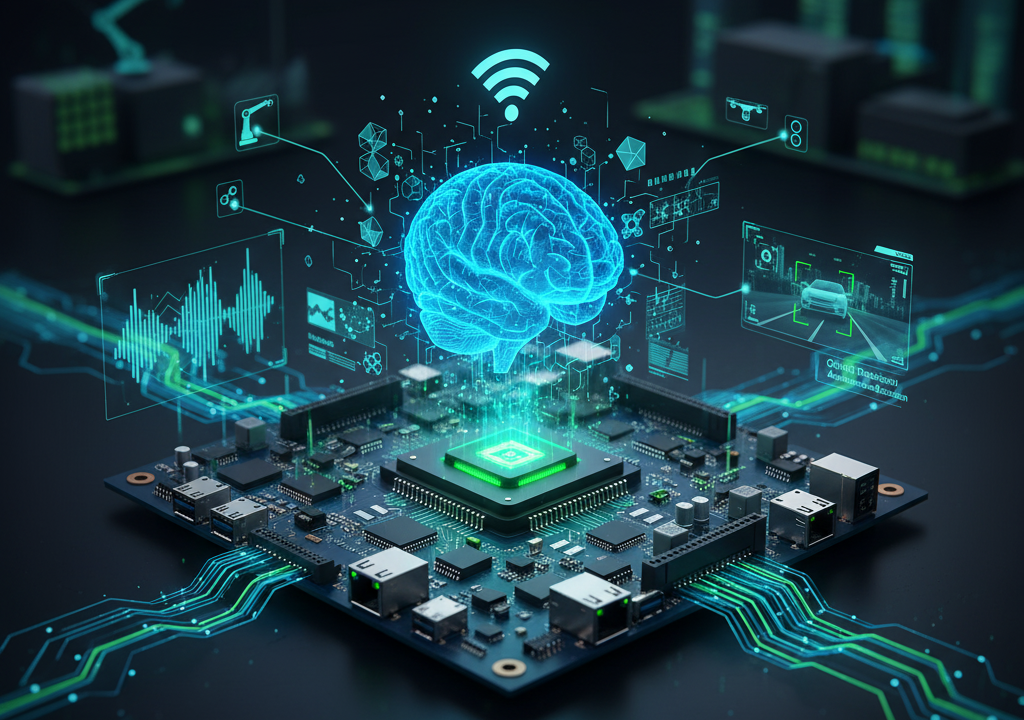
Edge AI vs. Cloud AI: A Comparison
To better understand when to choose one or the other, or how to combine them in a hybrid approach, let’s look at the key differences between Edge AI and Cloud AI
Features |
Edge AI |
Cloud AI |
Location |
Directly on the end device (sensors, robots, cameras, gateways) | Remote data centres, cloud servers |
Latency |
Very low, real-time processing | High, depends on distance and bandwidth |
Bandwidth |
Low, only relevant data or results are transmitted | High, large volumes of raw data are transmitted |
Security/Privacy |
High, data remains locally | Depends on cloud provider and transmission policies |
Reliability |
Operates offline, high resilience | Requires constant connectivity |
Computing Power |
Limited (optimised for efficiency) | Almost unlimited (large scale, powerful GPUs) |
Operating Cost |
Low for processing, high for initial hardware | High for resource usage (pay-per-use), low for initial hardware |
Flexibility |
Lower, requires optimisation of specific models | High, complex models, easy to update |
Typical Use Cases |
Autonomous vehicles, drones, robotics, industrial machine vision, offline predictive maintenance | Big data analysis, complex model training, natural language processing, recommendation systems, chatbots |
Hardware: The Heart of Edge AI
The success of any Edge AI project depends, to a large extent, on choosing the right hardware. We are no longer talking only about powerful CPUs, but about a range of specialised components designed for efficiency and performance at the Edge.
The Edge AI revolution is visible across a range of industries. Security systems can now detect intruders autonomously, industrial robots adapt to their environment in real time to optimise processes, and medical devices analyse data for more accurate diagnoses on the spot. It is also evident in transport, with autonomous vehicles making crucial road safety decisions in milliseconds.
To make this possible, hardware that can execute intelligence on the device is required. Key components for Edge AI development include:
- Microprocessors (MCUs/MPUs) with ML capabilities: Increasingly, manufacturers are integrating machine learning (ML) accelerators or neural processing units (NPUs) directly into chips, enabling lightweight model inferences to be executed with very low power consumption.
- Graphics Processing Units (GPUs) and AI Accelerators: For more intensive tasks such as computer vision or signal processing, compact GPUs or specialised chips (TPUs, FPGAs, ASICs) offering high parallelism are required. Leading manufacturers such as ASUS IOT, Axiomtek, and Seco, which implement solutions from Intel, Nvidia, and Hailo, are at the forefront of creating these high-performance accelerators.
- Smart Sensors: Sensors with data pre-processing capabilities and integrated filters that reduce the load on the main processor.
- Advanced Connectivity Modules: 5G, LoRaWAN, NB-IoT or Wi-Fi 6 modules for efficient and reliable communication with the cloud or between devices.
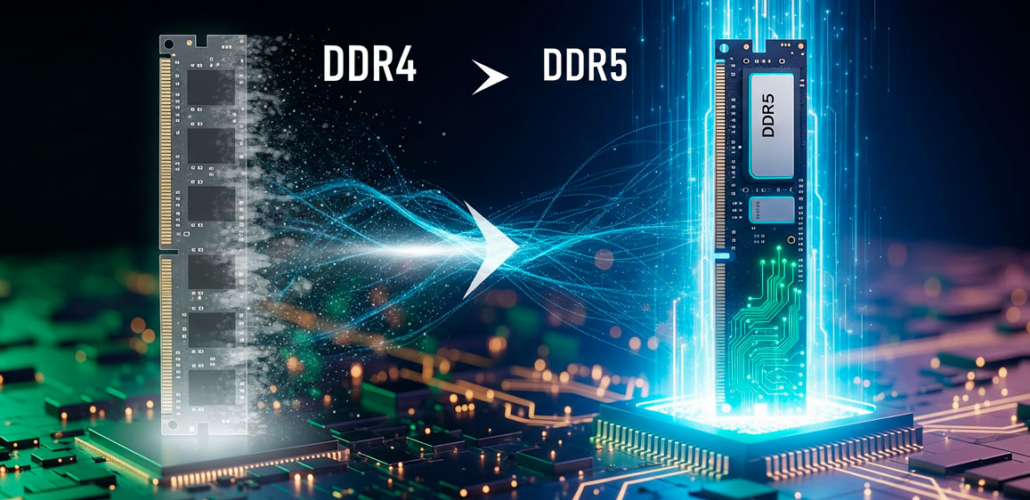
- Optimised Memory: RAM and storage (eMMC, NVMe) that can handle the speed and volume of data required by AI models.
Your Partner in Hardware for Edge AI
At Matrix, we understand that bringing your Edge AI ideas to life requires more than just software. You need robust, efficient, and reliable components to form the foundation of your project.
We work with leading manufacturers to offer you a specialised selection of:
- Industrial edge computers
- MPUs with integrated ML accelerators
- Compact, low-power machine vision modules
- Edge AI-optimised development boards, ready for prototyping.
- State-of-the-art connectivity modules to ensure your device’s communication.
- High-quality passive and active components to guarantee the stability and performance of your design.
👉 Are you designing your next AI-enabled embedded system? Looking to optimise the performance and efficiency of your solution at the edge?
👉Our team of experts is ready to advise you on selecting the perfect components for your next project.
👉Don’t leave your AI stuck in the cloud! Unleash its true potential at the edge with the right hardware.