
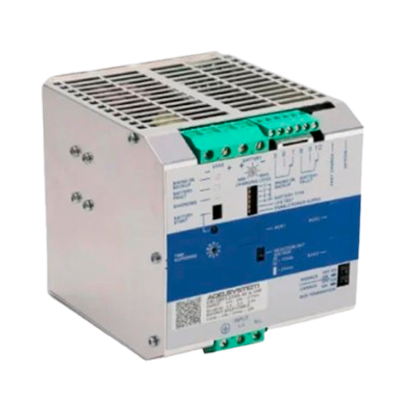
DC-UPS (DC Backup Power)
DC-UPS modules provide DC backup power to keep loads powered during mains power failures or voltage drops. They are integrated alongside an AC/DC power supply and a battery (or supercapacitor bank) to ensure power continuity at 12/24/48 V in automation, security, and communication systems.
Main Functions
- Battery charging and management (lead-acid, AGM, Gel, and LiFePO4, depending on the model) with current and voltage control.
- Automatic switchover between mains power (power supply) and battery, with no noticeable interruption.
- Monitoring via a DC OK signal, alarm relay, and/or dry contacts.
- Protection against reverse polarity, short circuits, overload, and deep battery discharge.
- Temperature compensation of the charging voltage (depending on the model) to extend battery service life.
Control and Monitoring
Models with integrated communication interfaces (depending on the model) allow the system to be monitored and configured:
- Ethernet: Modbus TCP, a web server for HTTP monitoring, and, on certain models, an API for integration with SCADA/BMS systems.
- CAN / CANopen: readout of battery/load voltage and current, status (mains/battery), alarms, heartbeat, and basic control via PDO/SDO.
- Modbus RTU (RS-485): monitoring of critical variables (battery voltage/current, charging current, temperature), alarms, and basic commands; direct integration with PLC/SCADA systems.
Communication interfaces enable functions such as event logging, telemetry, adjustment of charging current and low-battery thresholds, and scheduled battery tests.
Form Factors and Mounting
- DIN rail modules with accessible terminals and clip-on mounting.
- Compact versions for electrical cabinets or chassis.
- Compatible with redundancy modules (OR-ing) to increase system availability.
Typical Applications
- Automation and control (PLCs, SCADA systems, sensors, and actuators).
- Security and CCTV, access control, and alarm systems.
- Telecommunications, routers, gateways, and network electronics.
- Home automation and building management systems (BMS).
- Instrumentation and industrial IoT.
Selection Parameters
- System voltage: 12/24/48 V DC.
- Charging current and required battery capacity (Ah) to achieve the desired backup time.
- Supported battery chemistry: lead-acid (AGM/Gel) or LiFePO4.
- Load power/current in backup mode and startup peak current.
- Required signalling and communication interfaces: Ethernet (Modbus TCP/HTTP), CAN/CANopen, or Modbus RTU (RS-485).
Integration Best Practices
- Size the AC/DC power supply to account for both the load and battery charging current.
- Use appropriate input/output protection (fuses, circuit breakers) and correctly sized wiring.
- Install the battery in a ventilated enclosure and observe thermal derating requirements.
- Verify transfer times and perform periodic battery tests.
Compatibility and Standards
Professional DC-UPS systems comply with electrical safety and EMC regulations (e.g., CE, UL, and RoHS). Certain models offer EMC Class B compliance and advanced diagnostic functions. Additional requirements may apply depending on the industry.
Some of our brands:

 More than 30 years of history
 National and international distribution
 Specialized comprehensive technical support
 Supplementary and synergistic portfolio
 Customized project development
 The most prominent brands
 One partner, all your needs