
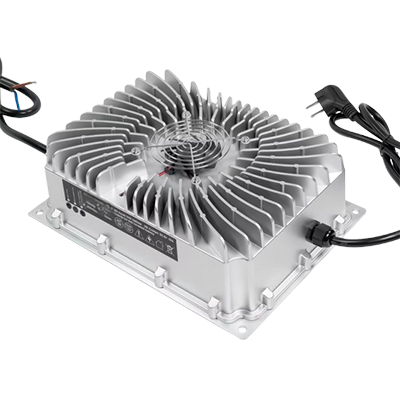
AC/DC Battery Chargers
AC/DC battery chargers convert mains voltage into a controlled output to safely charge lead-acid (AGM/Gel), lithium-ion, and LiFePO4 batteries, among others. They incorporate CC/CV and multi-stage charging profiles to maximize the service life of the energy storage system.
Charging Profiles and Control
- CC/CV (constant current / constant voltage) with precise current limiting.
- Multi-stage charging: Bulk, Absorption, Float, and optionally Equalize for lead-acid batteries.
- Temperature compensation of the charging voltage using an NTC/RTD sensor.
- Battery detection and low-battery cutoff control to prevent deep discharge.
- Specific charging profiles for Li-ion/LiFePO4, including pre-charge management and voltage verification.
Electrical Performance
- Universal input of 90–264 VAC (DC input option) and high efficiency; active PFC in medium- and high-power models.
- Output voltage ranges: 12/24/36/48 V and higher, with currents ranging from a few amperes to tens or hundreds of amperes, depending on the model.
- Protection features: reverse polarity, short circuit, OVP/OCP/OTP, safety timers, and anti-spark protection (depending on the model).
- LED indicators and relay signals for DC OK, charging status, and alarms.
Communication and Monitoring (Depending on the Model)
- Modbus RTU (RS-485) and Modbus TCP/Ethernet for integration with PLC/SCADA/BMS systems.
- CAN/CANopen for automotive and onboard applications.
- RS-232/USB with SCPI commands in programmable laboratory chargers.
- Functions include voltage/current (V/I) readings, temperature, status, alarms, event logging, and parameter adjustment.
Form Factors and Mounting
- DIN rail mounting for electrical control panels and automation systems.
- Chassis-mounted and encapsulated versions for OEM integration.
- Onboard chargers for vehicles and transportation applications (12/24/48 V).
- High-power programmable laboratory power supplies/chargers.
Applications
- UPS/DC-UPS systems and emergency backup power.
- Telecommunications, CCTV, and networking.
- Light electric mobility, industrial vehicles, buses, and boats.
- Renewable energy and energy storage systems.
- R&D and laboratory testing for validation and test purposes.
Selection Parameters
- System voltage and battery chemistry (lead-acid, Li-ion, LiFePO4).
- Capacity (Ah) and target charging current (e.g., C/10, C/5).
- Requirements for active PFC, telemetry, and communication protocols (Modbus/CAN/Ethernet).
- Thermal conditions, ventilation, and operating environment (IP/EMC).
Best Practices
- Verify charging profile compatibility with the battery and its BMS.
- Install appropriate protection devices (fuses/circuit breakers) and use correctly sized wiring.
- Schedule maintenance, including periodic testing and temperature monitoring.
Some of our brands:

 More than 30 years of history
 National and international distribution
 Specialized comprehensive technical support
 Supplementary and synergistic portfolio
 Customized project development
 The most prominent brands
 One partner, all your needs